
The Context
Ghinua, a young tribal man living near the forest, is renowned for his exceptional archery and hunting skills. Hunting ferocious animals such as tigers and bears is part of his everyday life. One day, a British government official, the Deputy Saheb, visits the forest for hunting. Impressed by Ghinua’s bravery and skill, he praises him and tells him that killing dangerous animals serves society and that the government rewards hunters for such acts. Ghinua takes these words literally, believing that eliminating any cruel or dangerous creature is a noble act deserving of a reward.
In Ghinua’s village, Laxman, a cruel and exploitative agent of the local landlord, terrorises the poor. One day, taking advantage of Ghinua’s absence, Laxman attempts to assault and forcibly take away Ghinua’s wife, Duiti.
Enraged, Ghinua sees Laxman as no different from a ferocious beast. Armed with his bow, arrows and axe, he tracks him down and kills him with a single blow. Feeling neither guilt nor fear, Ghinua believes he has performed a heroic act for his community and will be rewarded by the government.
He places Laxman’s severed head in a sack and walks to the town courthouse. Before the judge and police, he proudly recounts his “hunt,” expecting a reward.
Instead, the law sentences him to death. Unable to understand why killing a dangerous animal earns praise while killing a “human monster” brings punishment, Ghinua remains bewildered even as he is led to the gallows.
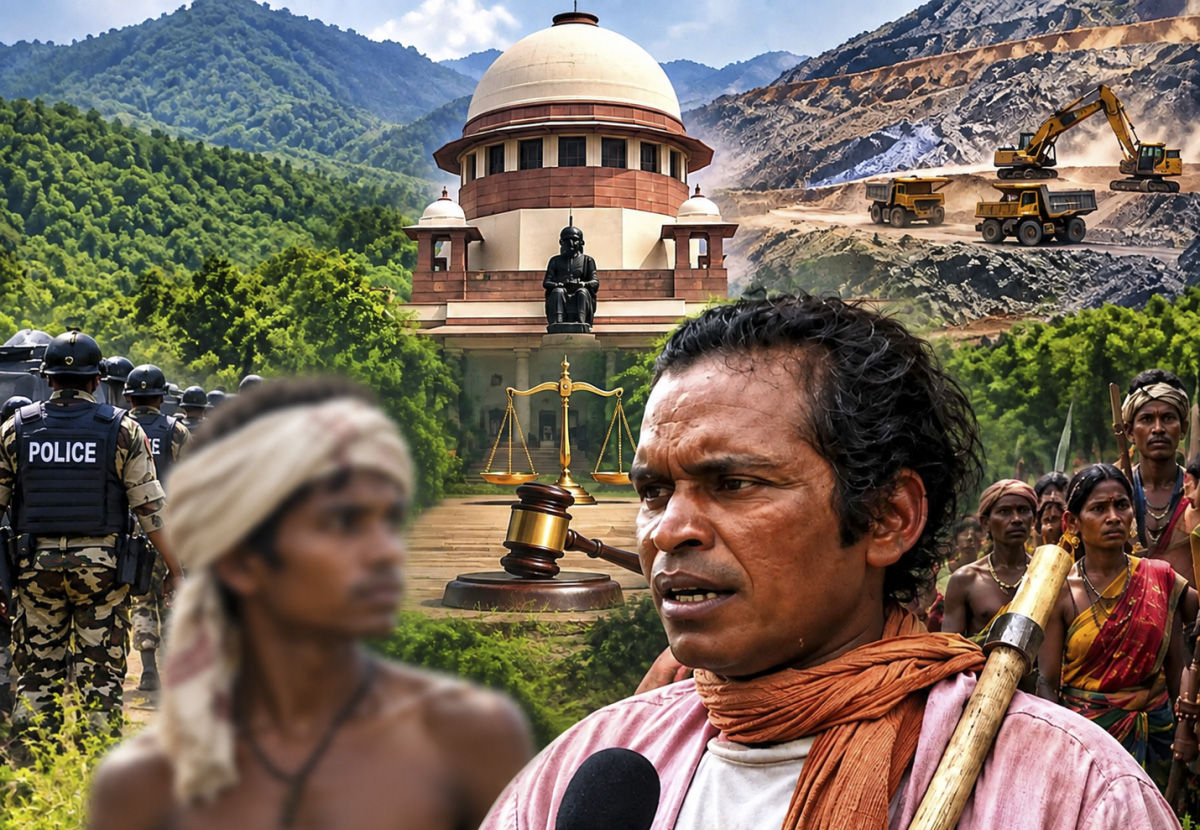
This is the story of a tribal man’s encounter with an exploitative landlord, the police, and the judiciary in his forest-dwelling community, portrayed by the great novelist Bhagabati Charan Panigrahi in his celebrated short story “Shikari” (1936). However, that was the imagination of Bhagabati Charan Panigrahi, but in the 21st century, another Tribal man, Lada Sikaka, who belongs to the Dongria Kondh, a Particularly Vulnerable Tribal Group (PVTG) from a remote village located inside the Niyamgiri Hill, is entangled in a similar situation with an exploitative mining giant, the police and the complex laws and justice system. Like Ghinua, Lada also has his own moral understanding of justice, but the modern complex society has failed to understand Lada’s life views and framework of understanding.
From Ghinua to Lada: A story to a real-life incident
Like Ghinua in the story of Bhagabati Charan Panigrahi, Lada in reality live inside a Niyamgiri Hills, located in Kalahandi and Rayagada districts and is a fearless man. He has also hunted many wild animals individually and with community members for hunting and gathering, which is a daily practice for living inside the forest with tigers, elephants, bears, wild boar, and other animals.
Like a middleman of the landlords exploiting the villages and harassing Ghinua’s wife, a mining giant also exploits the forest for extracting mineral products and, one fine day, kept its eye on the Niyamgiri Hill. Like the middleman constantly exploiting and terrorising the local community in the locality of Ghinua, the mining activities also exploited many forests before coming to Niyamgiri. As Ghinua gets enraged knowing the harassment of his wife by the middleman, Lada also gets enraged when he learns that a mining giant is going to exploit and destroy the Niyamgiri forest. For Ghinua, who fought against the perpetrator of which wife, but for Lada, he fought to save Niyamgiri and Niyamraja—the motherland and abode of his God—against the mining giant.
Like Ghinua, who took action against the monster middleman to protect the modesty of his wife and save his society from terror and exploitation, Lada is protecting his motherland and the abode of his God, Niyamraja, vis-à-vis his life, livelihood and society. He led the movement from the front in this mission. He believes that without Niyamgiri, they cannot survive. His motherland and the abode of Niyamraja are in danger. In his moral understanding of justice, he is sincere and dedicated to his duty to protect his motherland and God from the exploitation of monster miners. That is not a crime for him to protect himself and his society. Lada’s understanding of justice is rooted in a different social and cultural framework—one in which Niyamgiri is simultaneously habitat, livelihood, community resource and sacred landscape
The Complex Administration and Justice System: Failing to Understand Ghinua in the Story to Lada in Real Life at Niyamgiri

Ghinua, after killing the middleman, reached the police station with an expectation of a reward after doing a good deed for his society—eliminating the monster middleman. For him, whether animal or human, the punishment is the same for doing the wrong thing against society, but the administration and justice system in modern society is so complex and complicated that he can’t understand. Similarly, Lada thinks he is not doing anything wrong by protecting his motherland, abode of Niyamraja, livelihood and society. However, the complex administration and justice system made him an accused and culprit. He still fails to understand what wrong he has done. He doesn’t even know how many cases are pending against him. Perhaps for the first time, he came into contact with any government administration was the police and not the education, public health, or rural development like Anganwadi, Teacher, or Block Development Officer. He has been arrested by the police thrice in the past and tortured. This is the fourth time he was arrested on 10th September 2026. More complex and complicated is that even after the Supreme Court in 2013 recognised the role of Gram Sabha to decide the cultural and religious rights over Niyamgiri Hill, Lada is still wanted by the modern justice system. Recently, a lower court judgment was passed directing the attachment of his property, declaring that he is an absconder. On the other hand, he has been living in his habitat, Niyamgiri, and he has not gone into hiding. Attachment of his property means attachment of Niyamgiri Hill, where he lives, practices hunting and gathering, cultivates, and worships his God, the Niyamraja. The limitation of the modern justice system is that it fails to understand indigenous worlds. Attachment of Lada’s property is impossible in his society when the idea of ‘property’ cannot easily be separated from the community’s habitat, livelihood, cultural identity and sacred relationship with Niyamgiri. Again, his rights—the community rights—over the Niyamgiri habitat are already recognised by the Supreme Court in 2013. That is how the proposed mining was halted. Therefore, Lada must be thinking that we won the case in 2013 at the Supreme Court; the Dongria Community themselves claimed their rights over Niyamgiri in 12 Gram Sabhas. Despite that, why are the same police and court putting me in jail and attaching my property—the Niyamgiri Hill—in 2026?
Concluding Remarks
The story of Ghinua ended at the gallows because the law could not recognise the moral universe from which he acted. Lada’s story is very similar and still unfolding. The question before us is not whether modern law should replace itself with customary justice, but whether a justice system can truly claim to be inclusive when the lived meanings of land, community, livelihood and faith remain invisible within its categories. Lada and Niyamgiri therefore present a larger question: when law encounters a different way of understanding justice, does the law merely punish the individual—or does it also reveal the limits of its own understanding?
About The Author




Leave a Reply