
Introduction
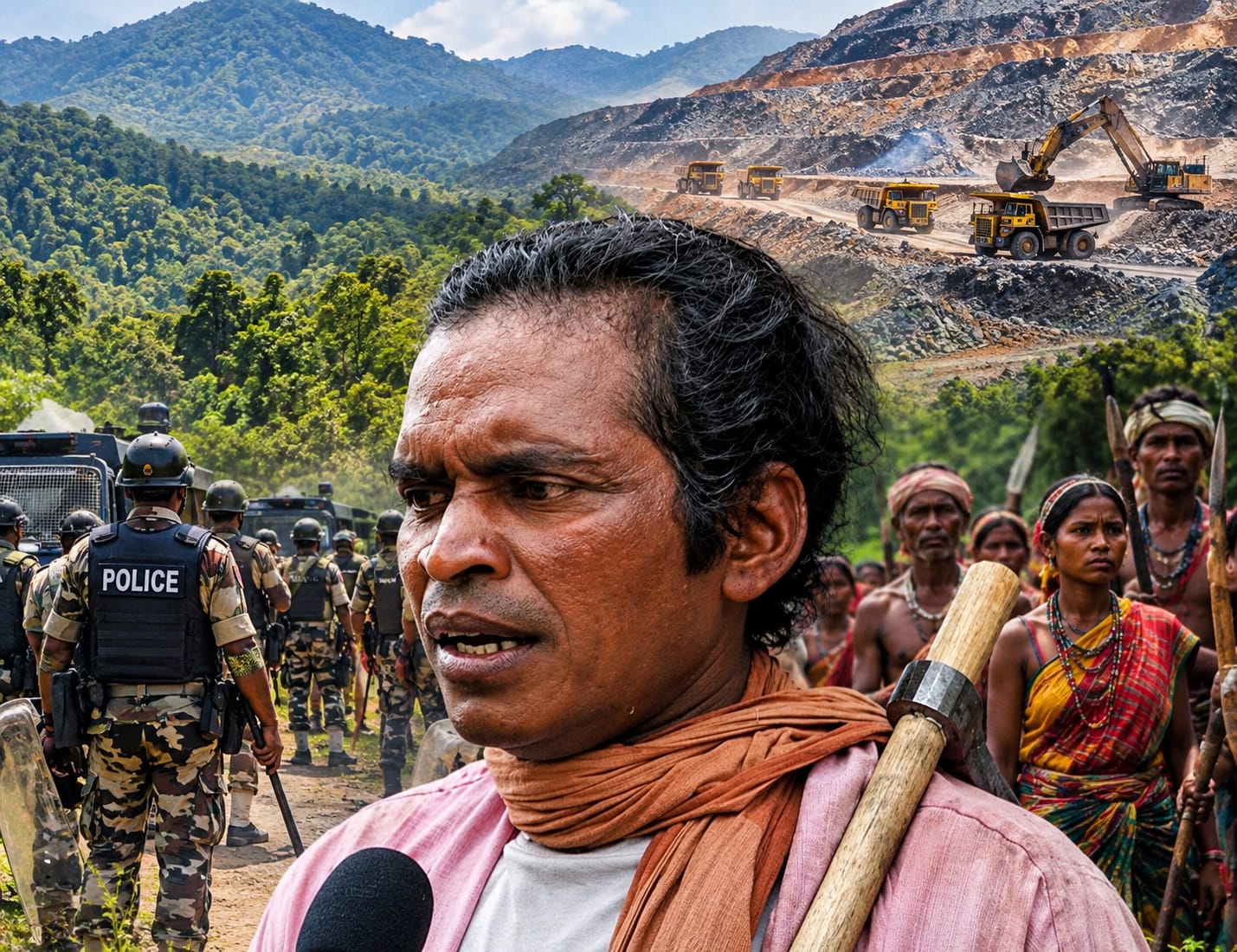
10th September 2026 is one of the black days for the supporters of the Niyamgiri movement. Lada Sikaka, the president of the Niyamgiri Suraksha Samiti got arrested by the Rayagada police once again after many years. According to his supporter, he received bail from the Lanjigarh court in a case, and on his way back home, police picked him up again in a different case. In a personal interview with Lada in 2023, he recalled and shared his police brutality during the peak of the Niyamgiri movement between 2006 and 2013, but things had returned to normality. Therefore, he would have never imagined that he is still wanted by the police after the Supreme Court judgment in 2013 referring to the Gram Sabhas to decide cultural rights over Niyamgiri and the subsequent cancellation of forest clearance for bauxite mining at the proposed Niyamgiri hill for Vedanta Alumina. In this article, Lada’s experience with police brutality during the movement phase has been shared with an analysis of why he is still a target for the police and mining giant.
Lada Sikaka, the Convener of the Niyamgiri Sukahya Samittee
Lada Sikaka belongs to the Dongria Kondh community (a particularly vulnerable tribal group, PVTG) in Niyamgiri Hill, Rayagada, Odisha. He is not unknown to the environmentalist, researcher and government administration and Vedanta Alumina. It is he and his associates behind the landmark Supreme Court of India judgement in 2013 that ordered the conduct of Gram Sabhas to decide the cultural and religious rights of the Dongria Kondh over Niyamgiri Hill, and they asserted their rights through Gram Sabhas. That is how the stage two clearance was halted. Since then, he has been known to the outside world as the leader of the Niyamgiri movement. He has led many protests, participated in various movements, and has become a symbol of courage, conviction and the resistance movement in India. Like other members of the Dongria Kondh community, he lives in his village hut made up of raw bricks and mud walls with a tin roof cover. There is no difference between him and other members in their living and livelihood. He goes to the forest for harvesting. His wife goes in the morning and comes back in the evening from their field. They all practice shifting cultivation and a barter system by exchanging agricultural produce like millets, pulses, ginger, and other food products. His wife still goes to the market, walking around 10 km carrying a basket full of agricultural products, like other women in the village. Lada has never gone to school, and there was no school or Anganwadi in his village or nearby village till 2023. In this situation, neither he nor his community has awareness of the police case or the judicial system, but he has been the most wanted by the police outside his village. They had no idea about mining, companies, steel, or they don’t need it either. They still use silver and earthen pots for their everyday use, a handmade ladle from a ripe fruit and a wooden handle. Their food is organic with millet as stapple food. They depend upon shifting cultivation and manage a self-sustainable livelihood purely based on agriculture and forest-based produces.

Police Atrocity on Lada Sikaka
In 2023, Lada shared his police case and arrest during the movement and narrates that ‘he has been arrested thrice without any reason, and the cases are pending. Initially, during the struggle, we faced huge police repression; a few of us had been arrested in the past, but now there is nothing like that. Recently, one or two days back, one police team came and asked me how I was doing. They saw my broken leg and said Get well soon’.
Recalling past painful arrest and police brutality, he further narrated that “once, I went to a meeting with other villagers in the nearby village. There were some men who asked us where we were going and asked my name. I said Lada Sikaka, and then they asked me for a discussion and took me away. Our people witnessed it, but they were like fools and did not protest. They took me and locked me inside their vehicle, which was kept a few meters away. They tortured me throughout the way till Rayagada. They kept me in a place where I regained my senses and asked me to go to the urinal. One police man pointed out a place, and I went literally crawling, as it was very painful and everywhere they were biting me. After some time, a person told me to meet their officer. I went to the room and saw a man. He asked my name, and I said Lada Sikaka. I also asked his name, and he said some Rao, which I forget now. He asked me about Maoists and said they are in the jungle. I answered I don’t know, therefore can’t say about them. I don’t know how they look alike. There are tigers, bears, and other animals in the forest, but can I say where they are? This way, they left me later”.
He also shared about his second arrest. He shared that “the second time, a policeman arrested me along with two or three villagers in Bissaum Cuttack and took me to Rayagada. While going to Rayagada, I sent one of the accompanying villagers to go to the village and inform them that I was being arrested. That is how our people came to know from him and protested against the arrest. That is how I was released again”.
The third time he said, “The Bissum-Cuttack police again arrested me and locked me up there inside the police station, but after the protest from our people, they released me”. However, he says it was painful physically and mentally when he says, “so, it was a very difficult phase for all of us, with the police and the Vedanta company”.
On the question of how do you see the future? He replied, “How can I say about the future? But one thing I am sure of: they will continue to fight; do not leave their land, forest and God. Our forefathers taught us and passed on the responsibilities to us, and we also advise our sons and daughters the same. They have to take pride in their culture, life and dignity and fight back. If they give away their land, they will lose everything, like the people in Damanjodi”. Here he refers to the tribal people affected by the aluminium company at Damanjodi, Koraput.
He shared that “I have been to Damanjodi once, where mining has been going on for a long time. There is now nothing left of the Kondh (our people) except the dry land and dust. They lost everything, and now they are not protesting. If their grandfathers or father gave away their land, at least if they protest now, they can stop it now, but they are not doing so. They tell me, we have done a good thing as we fought back and resisted the company for mining. This way, if our future generation will give away, they will see it like them with empty hands”.
However, according to Lada Sikaka, police surveillance and atrocities took place only after Vedanta Company came to Lanjigarh and proposed to mine on their sacred hill. He has been arrested thrice by the police under various charges that he does not know. He further shared that he had no idea about the police and sarkar (he indicates the state and government as sarkar) before Vedanta Company came here. They were indeed living their own life happily, with full freedom on the top of the hill without disturbing the outside world, but it was the outside world that went to disturb their life, livelihood and culture.
Arrest of Lada Sikaka: a sign for fear or force?
Lada Sikaka is a man full of self-respect and dignity and takes pride in their culture and life. He is a man with discipline and is not greedy. He says that ‘he has been offered English liquor by many company supporters, but I refuse it and take only salapa rasa (a juice made from the salap tree used as alcohol)’. He is always cheerful and has a smile on his face. He is a very simple man by nature and understands the politics of outsiders and the company well in his own way. He stood like a rock to all kinds of state oppression mediated through the police and Vedanta alumni company. However, this is settled for some time only and not permanently, as the state government keep raising the issue of the mining lease with the Vedanta company. Although the licence to Vedanta was halted after the Gram Sabhaas but, the police patrolling and surveillance have increased in the areas by creating various check posts.

For the last two years, one after another, prominent leaders of the movement like Krushna and Upendra have been arrested by Rayagada police and now released on bail. A few months back, Lingaraj Azad, the prominent leader of the Niyamgiri movement, was arrested, in March. For the last few years, a resistance movement has been going on at Sijimali in Koraput opposing bauxite mining. Police highhandedness towards local Dalit and Adivasis in Kantamal of Sijimali area was also the point of discussion earlier. Therefore, the Niyamgiri movement is an example of victory and provides strength to the movement at Sijimali, and the government does not want it. There may also be a chapter 2 on Niyamgiri bauxite mining, since it has been a demand from the Odisha government again and again. Besides, a few mining projects are proposed in Kalahandi and Nabarangapur, and the government fear that the leaders of the Niyamgiri movement will affect their projects. Again, Odisha is witnessing protests over the Mining and Mineral (Development and Regulation) Amendment Act 2026. However, that should not be the reason to harass simple and innocent people like Lada Sikaka. According to Lingaraj Azad (2023), “police have framed the innocent Dongria Kondhs and their supporters under false charges and have slapped UAPA charges on them for defending their rights, which is a blatant misuse of power against the tribes. There have been multiple cases and arrests of more than 20.” Finally, the reasons are best known to the administration and police, but it can be assumed that either Niyamgiri Hill is still in the pipeline for Vedanta, or the leaders of the movement are victims of successful resistance, with a fear that others will not get inspiration from them. Otherwise, there is no reason to scratch the old wound for the police in Rayagada and Kalahandi. It is the use of force out of fear for a similar movement.
About The Author



Leave a Reply