
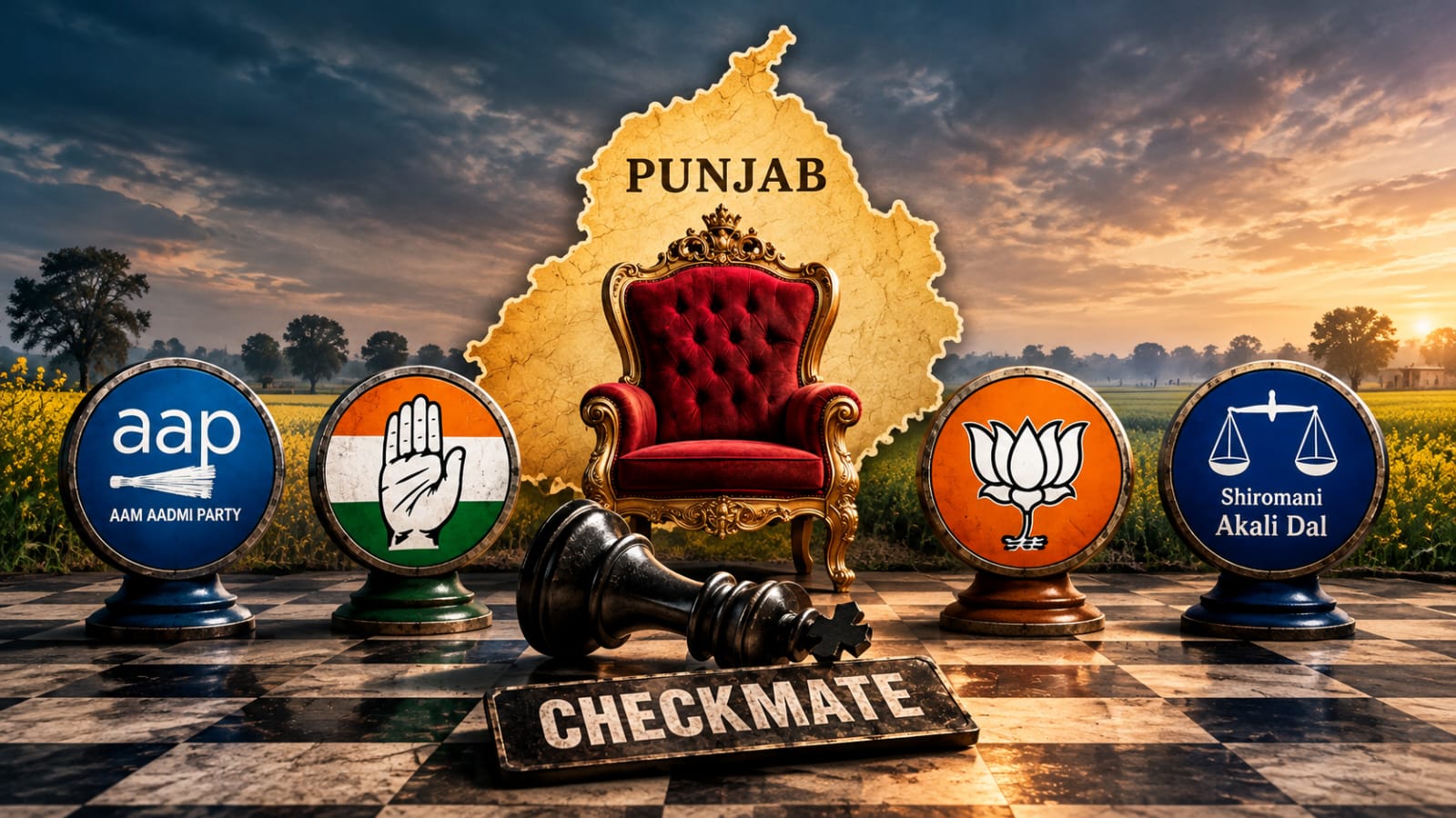
Punjab’s election results are often described as volatile. The description is accurate, but incomplete. What appears as volatility is also political decision shaped by memory, social location and repeated disappointment. The village gathering space known as sath, the dera, the farmer union, the diaspora conversation and the mobile phone screen all help form public opinion. Punjab can invest hope in a political formation with unusual intensity and withdraw it just as decisively. The important question before the 2027 Assembly election is therefore not simply who may win, but why no party has been able to retain Punjab’s trust for long.
That question places credibility at the centre of the post Badlav phase. Credibility is not the same as popularity, welfare delivery or persuasive communication. It is the ability to make political language, public procedure and administrative performance correspond over time. A party becomes credible when citizens can anticipate how it will use power, recognise fairness in its institutions and see promises survive the pressures of office. Every major party in Punjab possesses social or organisational resources. None has yet converted them into durable trust.
The Aam Aadmi Party’s victory in 2022 grew out of exhaustion with the established order. Its 92 seats in a House of 117 represented more than a landslide. The promise of Badlav brought together resentment against dynastic entitlement, corruption, factional politics and the distance between governing elites and ordinary citizens. AAP’s outsider status gave that promise moral force. It also imposed a demanding test. A party elected because it stood apart from the old order would eventually be judged by whether it changed the institutions, incentives and everyday conduct through which that order reproduced itself.
AAP can point to subsidised electricity, neighbourhood health services, investment in schools and cash support for women. These measures matter to households burdened by costly education, health care, insecure work and migration anxiety. Relief should not be dismissed as mere populism. Yet welfare expansion and energetic publicity do not by themselves establish credibility. The government must still answer whether policing is more accountable, employment opportunities have widened, the drug problem has weakened and action against corruption follows consistent rules. Its central risk is that the visibility of communication may exceed the visibility of institutional change. When citizens continue to experience arbitrariness, the distance between promise and everyday life becomes politically damaging.
The 2024 Lok Sabha verdict reflected this caution. Congress won seven of Punjab’s 13 seats, AAP three, the Shiromani Akali Dal one and Independents two. The BJP won no seat but increased its vote share to 18.56 per cent. This was not a simple transfer of allegiance. AAP was checked, Congress recovered without becoming dominant, the Akali Dal retained a foothold, the BJP expanded without overcoming its regional limits and independent victories revealed discontent that established parties could not absorb. The result did not identify a trusted alternative. It disclosed fragmented distrust.
Congress’s difficulty is not survival but purpose. It retains social breadth, experienced cadres and institutional memory, but electoral viability is not the same as a persuasive political project. It still has to frame a coherent Punjab argument connecting federalism, agrarian transition, employment, social justice and administrative reform. Recovery can create an opening, but it cannot substitute for political imagination.
The Shiromani Akali Dal, particularly the Badal-led formation, is struggling to retain political space. Its authority has been weakened by the sacrilege controversy, contested alliance choices and persistent internal divisions. Yet its political relevance cannot be understood solely through the lens of its recent decline. As Punjab’s major regional party, it remains historically positioned to articulate federal concerns, Sikh institutional interests, agrarian matters and demands for regional autonomy. Its recovery, however, depends on organisational renewal and greater internal democracy. The emergence of more assertive Akali and panthic formations does not necessarily indicate a uniform radicalisation of Sikh politics; rather, it suggests that unresolved questions of representation and justice are seeking alternative political expression.
The BJP has gained organisational depth and support among sections of the urban electorate concerned with commerce, security and stability. Its central welfare schemes, cadre expansion and improved vote share deserve serious attention. Yet Punjab cannot be treated as an uncomplicated extension of majoritarian politics elsewhere. Sikh historical memory, the farmers’ movement, concerns about centralisation and the state’s border location shape how national power is understood. The BJP’s prospects depend on recognising Punjab’s distinctiveness as a democratic and federal claim rather than viewing it mainly through security.
These party contests unfold within a social field that religion alone cannot explain. Sikh institutions, dera networks, Dalit assertion and urban Hindu anxieties interact with caste differences across Doaba, Malwa and Majha. Migration reorganises family ambition, while unemployment deepens the desire to leave. Fiscal pressure narrows developmental choice. Paddy dependence, groundwater depletion and soil fatigue turn ecological stress into a livelihood crisis. Diaspora networks reshape political aspiration, while digital media recirculates memories of 1984, militancy, police excess, farmer protest, river waters and corruption. These are not disconnected issues. They are the conditions through which political claims are interpreted and credibility is granted or withheld.
Punjab’s experience reflects a wider social science insight. Political identities are not fixed inheritances. They are reworked through institutions, leadership, conflict and memory. A seemingly unified Punjabi or Sikh political community contains distinct histories of caste, region and class. Electoral swings therefore need not indicate ideological emptiness. They may instead express a citizenry that repeatedly finds its aspirations recognised symbolically but not secured institutionally. Punjab’s problem is not that it remembers too much. It is that parties have struggled to translate memory, dignity and regional aspiration into dependable institutions.
The state’s fiscal and ecological constraints make this institutional question urgent. Punjab’s 2026 to 2027 Budget estimates outstanding liabilities at 45 per cent of GSDP, while salaries, pensions and interest payments are projected to account for 72 per cent of estimated revenue receipts. This leaves limited room for education, health, employment generation and ecological repair. The political consequence is clear: every promise of welfare, jobs or agricultural transition must now confront a severely restricted fiscal space. Credibility will depend not only on announcing priorities, but on explaining trade offs honestly and distributing costs fairly.
The 2027 election will therefore be a post Badlav election. The desire for change has not disappeared, but the word no longer carries the innocence it possessed in 2022. Punjab has watched a party of protest assume the burdens of incumbency, a national opposition party recover without fully renewing itself, a regional party confront the weight of its past, more assertive panthic formations occupy spaces of unresolved representation and the party governing at the Centre seek entry into a political culture it does not yet command.
Punjab is not simply searching for another slogan of rupture. It is searching for evidence that change can survive contact with power. Credibility will belong to the formation that can align language with procedure and performance, acknowledge achievement without exaggeration, admit failure without evasion and accept limits on its own authority. The deeper question in 2027 will not be who captures office, but whether any party can persuade Punjabis that public power can be exercised predictably, fairly and with enough humility to deserve trust beyond a single mandate.
About The Author




Leave a Reply