
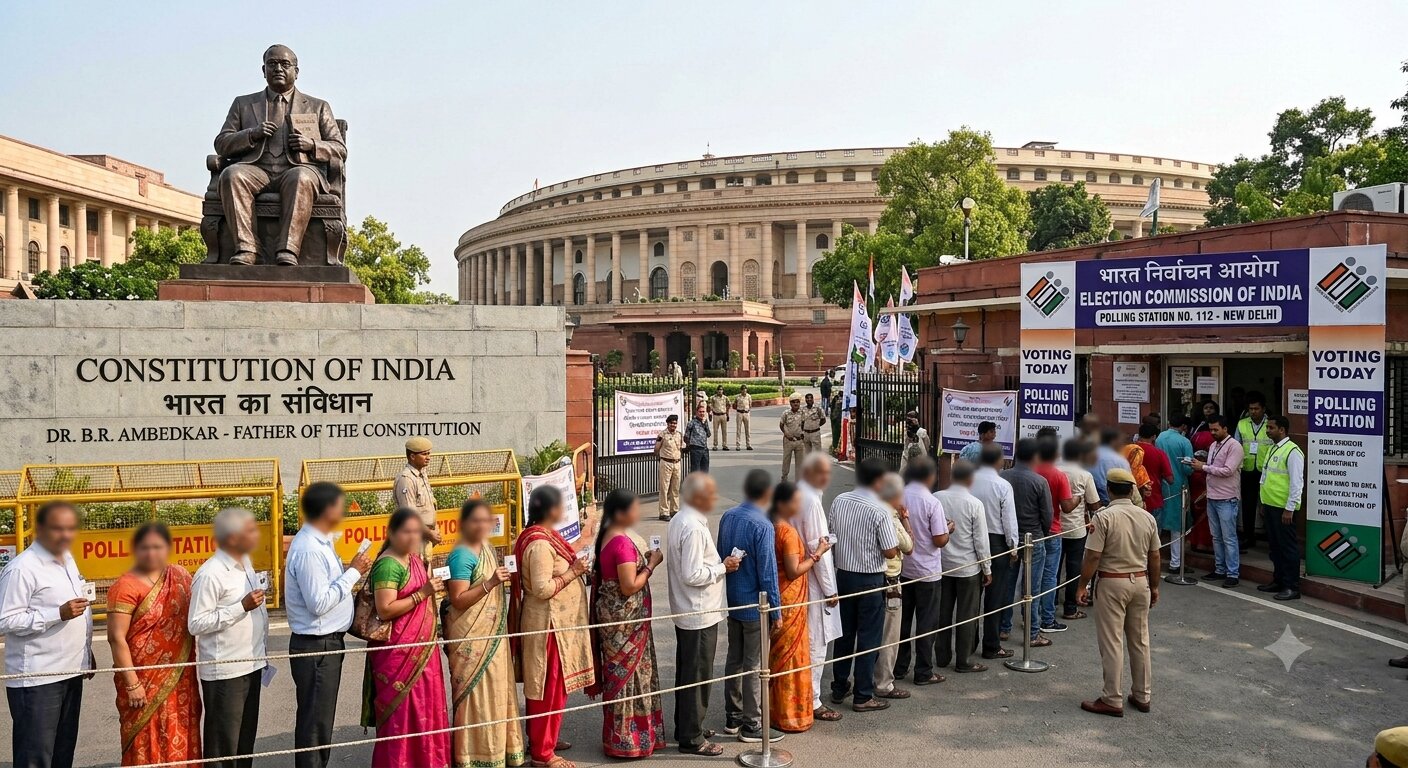
At a time when the credibility of the Election Commission of India (ECI) is under growing scrutiny, the conduct of free and fair elections has also come under serious question. Revisiting B. R. Ambedkar’s ideas of independent Election Commission, universal adult franchise and electoral rolls is the need of the hour.
The Special Intensive Revision (SIR) of electoral rolls has reportedly resulted in around 13 crore voters being left out of the draft electoral rolls, leading to significant political controversy and litigation. In West Bengal alone, more than 90 lakh voters have reportedly been excluded from the electoral rolls, while in Punjab, the number of deletions is reported to be more than 20 lakhs. The situation has become even more contentious amid reported differences among the three Election Commissioners over decisions concerning the inclusion and deletion of voters.
For Ambedkar, universal adult franchise was central to democratic citizenship, and excluding an eligible citizen from the electoral roll was a serious injustice. He also emphasised the need for an independent Election Commission that could function without executive influence or control. Revisiting these constitutional debates is therefore important for understanding the present concerns surrounding electoral rolls, institutional independence and the right to participate in India’s democratic process.
Independent Election Commission and the Idea of Free and Fair Election
The Constituent Assembly’s concern was that free and fair elections could be compromised if the executive government had direct control over the electoral machinery. The argument Ambedkar provided is that the government of the day could transfer or deploy officials in ways that might benefit a preferred candidate or ruling party when he says:
Many people felt that if the elections were conducted under the auspices of the Executive authority and if the Executive authority did have power, as it must have, of transferring officers from one area to another with the object of gaining support for a particular candidate who was a favourite with the party in office or with the Government of the day, that will certainly vitiate the free election which we all wanted. It was therefore unanimously resolved by the members of the Fundamental Rights Committee that the greatest safeguard for purity of election, for fairness in election, was to take away the matter from the hands of the Executive authority and to hand it over to some independent authority. (Dr. Babasaheb Ambedkar: Writings and Speeches Vol. 13, P. 23)
Administrative interference could undermine the neutrality of elections even without directly manipulating the vote. The proposed solution was therefore to remove electoral administration from the control of the executive and place it under an independent authority. This reasoning is important for understanding the constitutional design of the Election Commission: its independence was conceived not merely as an administrative arrangement but as a democratic safeguard against the misuse of state machinery for electoral advantage. It shows that the concern about electoral independence was a point of discussion during the framing of the Constitution and was linked directly to the broader principle of free and fair elections. That is how the idea of an independent Election Commission came into place.
Citizens’ Right to be Included in the Electoral Rolls
Ambedkar’s speech in the Constituent Assembly highlights a fundamental concern about the electoral roll. According to him, the right to vote should not depend on a person’s race, language, culture, or status as a “native” of a particular province. He drew attention to reports that provincial governments were manipulating electoral-roll preparation to exclude people who were considered culturally, linguistically, or racially different from the dominant population. When he says:
There are what may be called original inhabitants, so to say, the native people of a particular province. Along with them, there are other people residing there, who are either racially, linguistically or culturally different from the dominant people who are the occupants of that particular Province. It has been brought to the notice of both the Drafting Committee as well as of the central Government that in these provinces the executive Government is instructing or managing things in such a manner that those people who do not belong to them either racially, culturally or linguistically, are being excluded from being brought on the electoral rolls. (Dr. Babasaheb Ambedkar: Writings and Speeches Vol. 13, P. 721)
His intervention therefore reflects the larger constitutional principle of universal and non-discriminatory political citizenship. The concern was not merely about the preparation of electoral rolls, but about preventing provincial authorities from deciding who was entitled to political participation on the basis of identity or place of origin. In this context, Ambedkar’s emphasis on electoral-roll safeguards can be understood as an attempt to ensure that citizenship and voting rights were protected against majoritarian or provincial discrimination. According to him, no injustice may be done to any citizen in India who, under this Constitution, is entitled to be brought on the electoral rolls. His strong statement on “no person shall be ineligible for inclusion in, or claim to be excluded from, any such roll on grounds only of religion, race, caste, sex or any of them” was radical yet progressive at the time when feudalism, caste-based discrimination, illiteracy and socio-economic inequality were highly pervasive in the 1950s.
Adult Franchise as a Fundamental Right in a Democracy
He also strongly reflected on the constitutional concern that the right to vote must not depend on the preferences of provincial governments or individual officials. He describes the franchise as “a most fundamental thing in a democracy” and argues that an eligible adult should not be excluded from electoral rolls because of local prejudice or administrative discretion when he says:
The House will realise that franchise is a most fundamental thing in a democracy. No person who is entitled to be brought into the electoral rolls on the grounds which we have already mentioned in our Constitution, namely, an adult of 21 years of age, should be excluded merely as a result of the prejudice of a local Government, or the whim of an officer. That would cut at the very root of democratic Government. In order, therefore, to prevent injustice being done by provincial Governments to people other than those who belong to the province racially, linguistically and culturally, it is felt desirable to depart from the original proposal of having a separate Election Commission for each province under the guidance of the Governor and the local Government. (Dr. Babasaheb Ambedkar: Writings and Speeches Vol. 13, P. pp. 721-22)
It is significant to highlight because it connects electoral rights with protection against regional, linguistic, cultural and racial discrimination. Ambedkar’s reasoning also explains why the Constituent Assembly moved away from the idea of separate provincial Election Commissions operating under Governors and local governments. A centralised Election Commission was seen as a safeguard against provincial interference in the preparation of electoral rolls and the conduct of elections. Thus, the argument was not simply about administrative efficiency; it was about creating an institutional mechanism capable of protecting equal political citizenship and the integrity of the democratic process across India.
Concluding Remarks
The current situation is deeply concerning, particularly because of the growing lack of trust and transparency in the functioning of the Election Commission. This raises serious questions about the spirit of Indian democracy which our framers of the Indian Constitution dreamed up.
In the 1950s, the framers of the Constitution were concerned about ensuring that no eligible citizen was left out of the electoral roll. Today, the concern has taken a different form, with reports suggesting that nearly 13 crore citizens are still waiting to be included in the electoral rolls.
At a time when there was a strong emphasis on decentralising the election process with a multi-member election commission, the system has increasingly become centralised in current days. The use of software and changes in the powers of Electoral Registration Officers (EROs) have further shifted control towards the central authority.
Even when opposition parties were absent in the early years of democracy, the framers and founding leaders remained deeply concerned about the need for a free, fair and independent Election Commission. Today, the situation raises serious concerns about institutional independence, particularly with greater power being concentrated in the office of the Chief Election Commissioner, including matters relating to appointments and changes in rules favouring the government of the day.
About The Author




Leave a Reply